Overview
Many first-year students enter mathematics for economics with uneven preparation in precalculus. Gaps in algebraic manipulation, logarithms, fractions, and quantitative reasoning can make it difficult for them to engage successfully with early course material and later calculus-based applications.
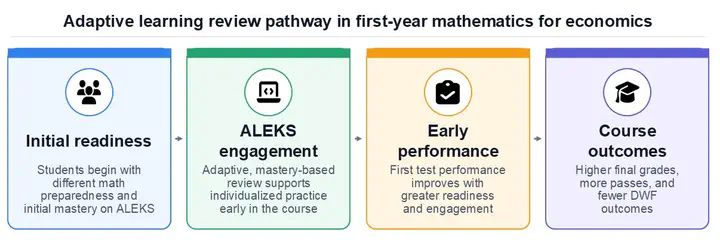
This project examines the use of ALEKS as a course-embedded adaptive learning system during the first four weeks of a first-year mathematics for economics course at a research university in Ontario, Canada. ALEKS was used to diagnose prerequisite knowledge, assign individualized practice, and support mastery of core precalculus topics before students moved further into the course.
Approach
During the early weeks of the semester, students completed formative assessments, practice activities, and quizzes in ALEKS, followed by a summative ALEKS assessment. The project then compared student engagement and performance in ALEKS with subsequent performance in the calculus-based portions of the course.
Key findings
Students reported that time spent in ALEKS improved their confidence, understanding, and willingness to continue in mathematically intensive fields. Higher engagement in ALEKS was also positively associated with stronger performance later in the course.
Significance
The project suggests that an adaptive, early-semester intervention can provide scalable support for students with heterogeneous mathematical backgrounds. It also highlights how course-embedded learning technology can strengthen readiness for quantitative work in economics and related disciplines.